ই-বর্জ্যের লাগসই পুনরাবর্তন

Loading...

ই-বর্জ্যের লাগসই পুনরাবর্তন

What is WEEE and eWaste?

  • Electrical and Electronic Products with circuity or electrical components with a power or battery supply.
  • It becomes WEEE (Waste of Electrical and Electronic Equipment) or e-Waste once it has been discarded by its owner as waste without the intent of reuse (Step Initiative 2014). Each product has different material content, is disposed of and recycled in differently ways.

  • Such Products are increasingly used in transport, health, security systems, and generators of energy, such as photovoltaics, IT/Communication Sector, IoT sensors or devices.

eWaste - Products & Categories

  • Cooling and freezing equipment >> refrigerators, freezers, air conditioners, and heat pumps.
  • Televisions, monitors, laptops, notebooks, and tablets.
  • Vacuum cleaners, microwaves, ventilation equipment, toasters, electric kettles, electric shavers, scales, calculators, radio sets, video cameras, electrical and electronic toys, small electrical and electronic tools, small medical devices, small monitoring, and control instruments.
  • Mobile phones, Global Positioning System (GPS) devices, pocket calculators, routers, personal computers, printers, and telephones.
  • fluorescent lamps, high intensity discharge lamps, and LED lamps.
  • Washing machines, clothes dryers, dishwashing machines, electric stoves, large printing machines, copying equipment, and photovoltaic panels.

Why is it a concern, Globally and Locally ?

E-waste is categorized as hazardous waste due to the presence of toxic materials such as mercury, lead and brominated flame retardants are considered as hazardous waste according to the Basel Convention.

  • Environmental Hazards
  • Occupational Hazards

CATHODE RAY TUBES (CRTS)

DISMANTLED PRINTED CIRCUIT BOARD PROCESSING

CHIPS AND OTHER GOLDPLATED COMPONENTS

PLASTICS FROM COMPUTER AND PERIPHERALS, E.G. PRINTERS, KEYBOARDS, ETC.

TONER CARTRIDGES

SECONDARY STEEL OR COPPER AND PRECIOUS METAL SMELTING

Global and Local volume of eWaste, where these goes?
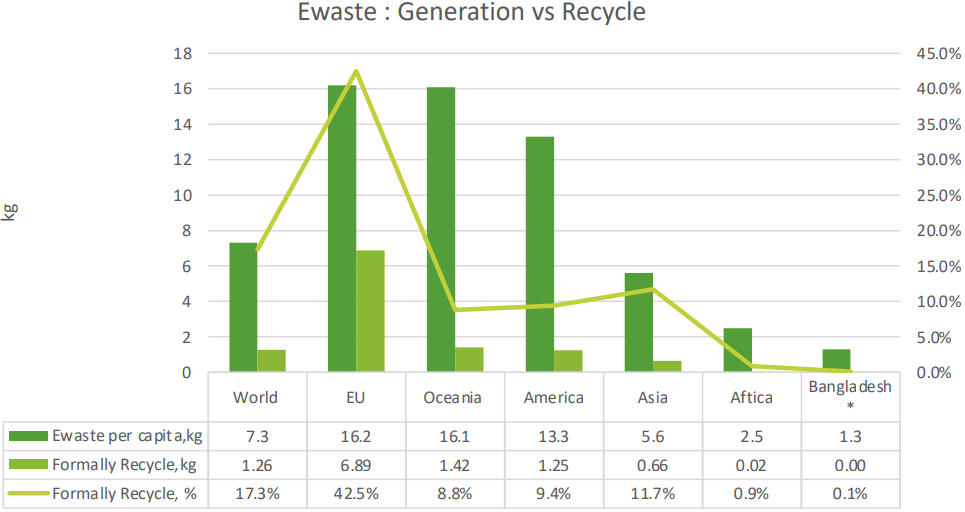
  • Fate of 82.7% e-waste is uncertain
  • Cross-boarder export/2nd hand use 7%-20%
  • The majority of undocumented domestic and commercial e-waste is probably mixed with other waste streams and informally recycled

How are these creating risk for us and future generation ?

  • E-waste contains several toxic additives or hazardous substances, such as mercury, brominated flame retardants (BFR), and chlorofluorocarbons (CFCs), or hydrochlorofluorocarbons (HCFCs). The increasing levels of e- waste, low collection rates, and non-environmentally sound disposal and treatment of this waste stream pose significant risks to the environment and to human health.

  • These #eWaste contain heavy metal and complex mixed gas. As per WHO Exposure to lead or heavy metal is associated with a wide range of effects, including various neurodevelopmental effects, Respiratory irritation, mortality (mainly due to cardiovascular diseases), impaired renal function, hypertension, impaired fertility and adverse pregnancy outcomes.

How we are preparing?

  • DoE proposal for legislative measures yet to approved
  • Formal recycling industry yet to develop
  • Informal recycling creating environmental and occupational hazard

আমাদের লক্ষ্য-

লাল সবুজের দেশে, ই-বর্জ্য মুক্ত সবুজের প্রত্যয়ে

– WEEE SOCIETY